 Mochi Style
From paper dolls to dress up apps: a short history
Long before tapping a closet tab, children cut out dolls and folded paper tabs over their shoulders. Here is how that simple game travelled from paper to screens.
In this guide
Dress up games began as paper dolls: a flat figure with separate paper outfits held on by little folding tabs. Printed sets made for children appeared in Europe in the early 1800s, and paper dolls later spread through books, magazines and newspapers. In the 1990s the same idea moved onto computers as "digital paper dolls", where you drag clothes onto a figure, and today it lives on in phone and tablet apps with recolouring, makeovers and challenges.
Every dress up app has the same simple heart: a figure in the middle and a pile of clothes to try on. That idea is much older than phones or computers. It started with scissors, card and a few paper tabs.
This guide follows the history of dress up games in a few short steps, from the first paper dolls to browser games and today's apps. It also shows you how to make a paper doll at home, so you can feel the difference between the old game and the new one for yourself.
Paper dolls: where dress up began
People have cut figures out of paper for a very long time. The dress up part, a doll with separate outfits that you swap, became a popular toy in Europe in the late 1700s, first as a fashion novelty for grown-ups.
Sets made just for children followed. One that historians often mention is "Little Fanny", a boxed paper doll story from the London publisher S. & J. Fuller around 1810. Each picture showed the same girl in a new outfit, and you placed her head into the clothes as the story went on. It is a lot like the "try it on" moment in a modern game.
The basic design was clever and stayed for generations:
- A flat doll, usually standing straight with arms slightly away from the body.
- Separate outfits drawn to fit that exact pose.
- Folding tabs on the shoulders and sides of each outfit, which bend behind the doll to hold the clothes in place.
Swap the outfit, and the doll has a new look. That is still the core loop of every dress up game.
Printed for everyone: books, magazines and catalogues
Through the 1800s paper became cheaper to make, and printing got faster. Paper dolls stopped being a rare treat. Publishers sold them in books and boxed sets, and magazines and newspapers began printing dolls on their pages so readers could cut them out at home.
Many families also made their own. Children cut models out of old shop catalogues and fashion pages, then drew extra outfits by hand. These home-made dolls are a nice reminder that dress up was always about designing, not only choosing.
Paper dolls often followed the fashions of the day, and some showed famous people of the time. Like a game with a theme of the week, they gave players a reason to come back for the next set.
From paper to pixels: the first digital dolls
In the 1990s home computers made it possible to drag pictures around a screen with a mouse. Hobby artists realised this was perfect for paper dolls.
In Japan, fans built the Kisekae Set System, usually called KiSS. "Kisekae" is a Japanese word for changing clothes, and KiSS sets were collections of a doll and clothing pieces you could move onto her with the mouse. People drew and shared their own sets, a lot like trading paper dolls.
Around the same time, people began making dress up pages for the web. Later, browser animation tools made it much easier to build them, and dress up games became a whole category of their own. A few new ideas arrived with the screen:
- No scissors. Clothes snap into place, and nothing tears.
- Layers. A jacket can sit over a top, and hair can sit over a hat.
- Recolouring. The same skirt can turn pink, blue or purple with one click.
- Endless clothes. A closet is no longer limited by the pages of a book.
Dress up games on phones and tablets
Touchscreens brought dress up even closer to paper. You use your finger again, just like placing a paper outfit, but the closet scrolls forever and the doll can come to life.
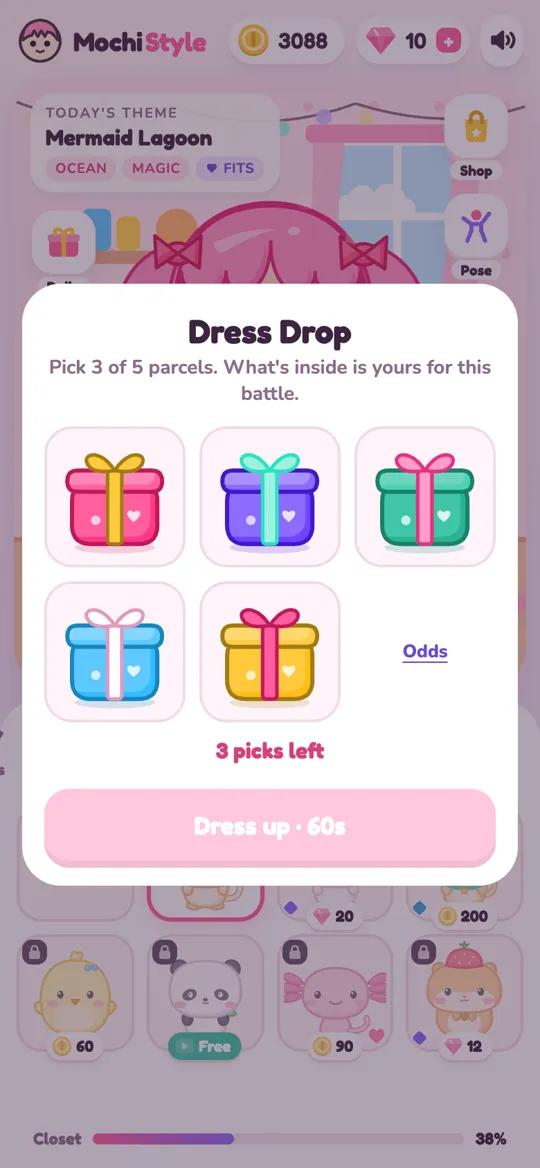
Modern apps keep the old loop of doll plus outfits, then add things paper never could. In Mochi Style, our own chibi doll dress up game, that means:
- Closet tabs for hair, eyes, faces, tops, skirts, dresses, shoes, hats, glasses and wings, sorted like the pages of an old paper doll book.
- Colours on tap. A row of swatches recolours almost every item, and sparkle colours and a rainbow picker can be unlocked.
- A doll with feelings. She blinks, giggles when tapped, makes wow eyes at sparkly things and pouts at the wrong outfit.
- Themes and challenges. Daily themes with three cute judges, and runway battles where you dress up in 60 seconds.
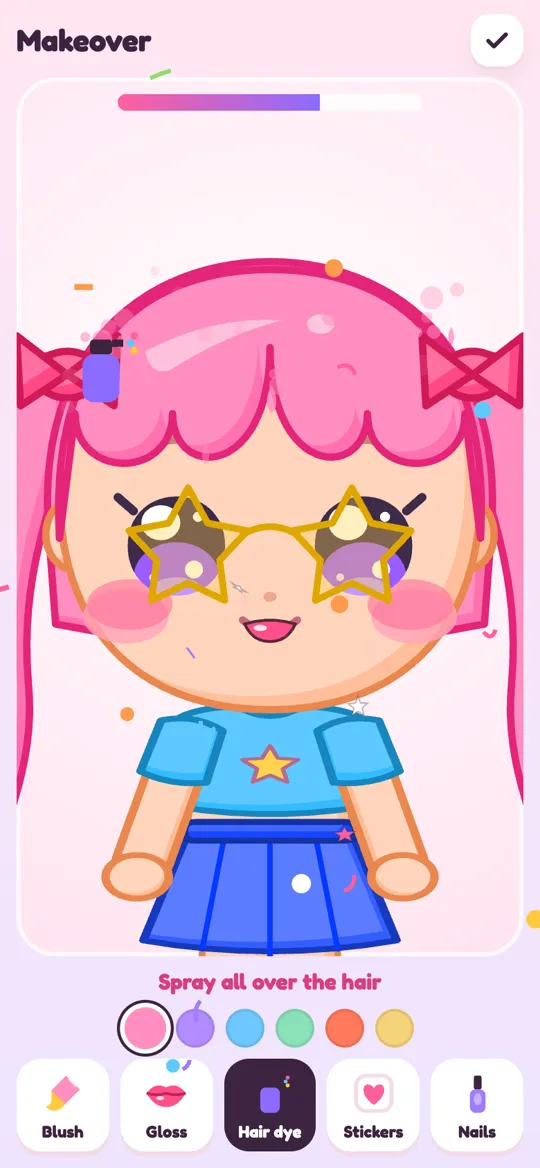
- A makeover studio. Blush, lip gloss, hair dye spray, sticker tattoos and nail painting.
Faces changed too. Many apps now use the cute, big-head chibi look instead of a tall fashion figure. Our comparison of chibi vs realistic dress up games explains how that changes play.
Make your own paper doll in six steps
The best way to understand the history of dress up games is to play the original. You need card or thick paper, a pencil, colouring pens and scissors. Younger children should have a grown-up help with cutting.
- Draw the doll. Draw a simple figure standing straight, arms a little away from the body, feet apart. Keep the shape chunky so it is easy to cut.
- Glue it to card. If you drew on thin paper, stick it onto a cereal box or card so the doll stands up to lots of play.
- Trace the outfits. Lay thin paper over the doll and trace around the body. Draw a top, a skirt or a dress inside those lines.
- Add the tabs. Draw small rectangles on the shoulders and sides of each outfit. Do not cut them off later, as these hold the clothes on.
- Colour and cut. Colour each piece, then cut carefully around the outfit and its tabs.
- Dress her up. Fold the tabs behind the doll. Make a little theme card, such as a party or a beach day, and design outfits to match.
Paper or screen: what each one teaches
Paper and apps are not rivals. They are good at different things.
- Paper is slow and hands-on. You design every piece yourself, and cutting and colouring take care.
- Apps are fast and playful. You can try lots of combinations and colours quickly and see a reaction straight away.
A fun way to mix both is to style a look in an app, then draw it as a paper outfit. Or try the reverse: design a paper outfit first, then see how close you can get with the closet on screen. For ideas on what a good app should include, read our guide to what makes a good dress up game. If you are a parent choosing one, our parent checklist for dress up games covers ads, purchases and privacy.
Mochi Style is a free kawaii doll dress up game for Android. There are no accounts and no chat, and your doll and outfits are saved on your device. It is coming soon to Google Play.
FAQ
When were paper dolls invented?
Paper dolls with swappable outfits became popular in Europe in the late 1700s. Sets made for children followed in the early 1800s, such as "Little Fanny" from a London publisher around 1810.
What were the first digital dress up games?
In the 1990s hobby artists made "digital paper dolls" for home computers. A well-known early example is the Kisekae Set System, or KiSS, from Japan, where you moved clothes onto a doll with the mouse.
What does kisekae mean?
Kisekae is a Japanese word for changing clothes. It is used for dress up dolls and gave its name to the KiSS digital paper doll format.
Why do paper doll clothes have tabs?
The tabs fold behind the doll to hold the outfit in place. They let you swap clothes again and again without glue.
Are paper dolls still made today?
Yes. Paper doll books are still printed, and many people draw and share their own. They are an easy, low-cost craft to make at home.
How is Mochi Style different from a paper doll?
It keeps the same idea of a doll and outfits to swap, then adds recolouring, a doll who reacts, pets, scenes, daily themes, runway battles and a makeover studio.